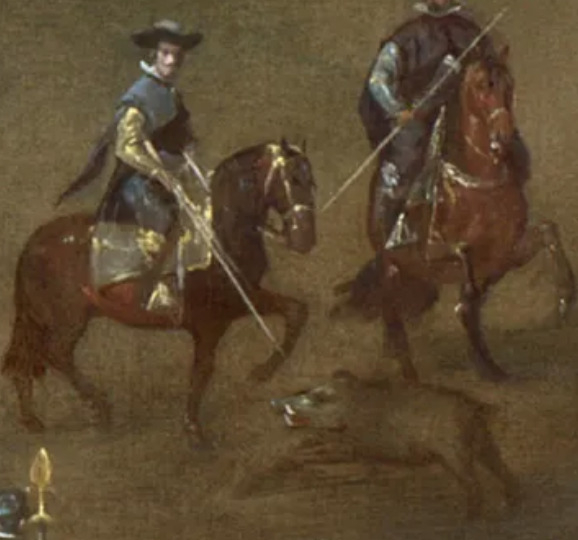



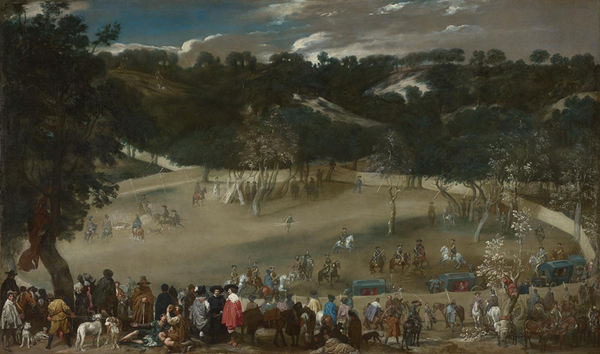
Measuring a king-size 72 by 119 inches, this is the artist's only known rendering of a documented event in the life of Philip's court. Its Spanish title La Tela Real ("The Royal Canvas") refers to the cloth enclosure surrounding a vast forest clearing, where—if we can find him—we see the monarch, sedate on horseback, poised to dispatch his frantic, strangely winsome prey. From a nearby carriage that is lined in scarlet like a box at the opera, Philip's first queen, Elisabeth of France, directs her gaze our way, not towards her husband's cautiously stage-managed heroics. On the hoi polloi's side of the fence, a barefoot picaro in red has found the perfect perch, up in the silver-white foliage of the tree at the lower left, a stone's throw from Their Majesties.
Between riders, chasseurs, packs of dogs, idlers, and other quarry, there's lots else happening out on the killing ground. Yet the figures who draw focus are the ones arranged along the bottom edge of the painting, outside the royal enclosure. To the far left, in the shade of a tree, a boy in white with a feathered hat stares straight at us.
Left of center, in the sunshine, a sober-suited hidalgo seems the odd man out between two dressy caballeros in deep conversation. An approximate count of humans and beasts in La Tela Real exceeds one hundred, the largest perhaps 12 inches in height, the smallest the size of your thumbnail. Who associates Velázquez with landscapes, let alone a landscape peopled with figures in miniature? Yet in every face and pose and gesture, he is present.

To call La Tela Real "curious," as Jonathan Brown does in his magisterial study Velázquez: Painter and Courtier (1986), may soft-pedal the matter. Except in numerous obligatory royal portraits, Velázquez never fell back on formulas. Each of his mythological and religious canvases takes a unique approach; his one and only history painting, the singularly humane Surrender of Breda, virtually reinvents the genre.
What's therefore doubly curious is the pigeonhole to which Brown assigns La Tela Real within his Velázquez checklist. No, it's not one of the two Landscapes, both depicting the Villa Medici. Instead, Brown includes La Tela Real as one of just three Group Portraits. But Balthasar Carlos in the Riding School, which is one of those three, doesn't really belong; it's an equestrian portrait of the seven-year-old crown prince before distant titled extras. Which leaves just one other group portrait: Las Meninas ("The Ladies-in-Waiting"), the Holy of Holies.
Painted two decades after La Tela Real, Las Meninas (1656) goes beyond the king-size to a monumental 125 by 110 inches, a "portrait" format verging on the Platonic solidity of a perfect square. We're in the artist's studio, momentarily the hub of the royal family's private life. Philip IV and his second wife Mariana of Austria are posing for a double portrait, as we see from their reflection in a mirror on the back wall. Their Majesties stand where we stand, and we're looking through their eyes. The living doll before them is the five-year-old Infanta Margarita, who has just danced in to check up on Mommy and Daddy, attended by her own entourage of ladies-in-waiting, a placid mastiff, and cherished dwarfs for entertainment. What we see on canvas is a self-portrait of Velázquez in the process of painting Philip and Mariana. But what the living Velázquez of the 17th century bewitched us with is the image of Philip and Mariana's little girl—the center of the painting and the center of their world.
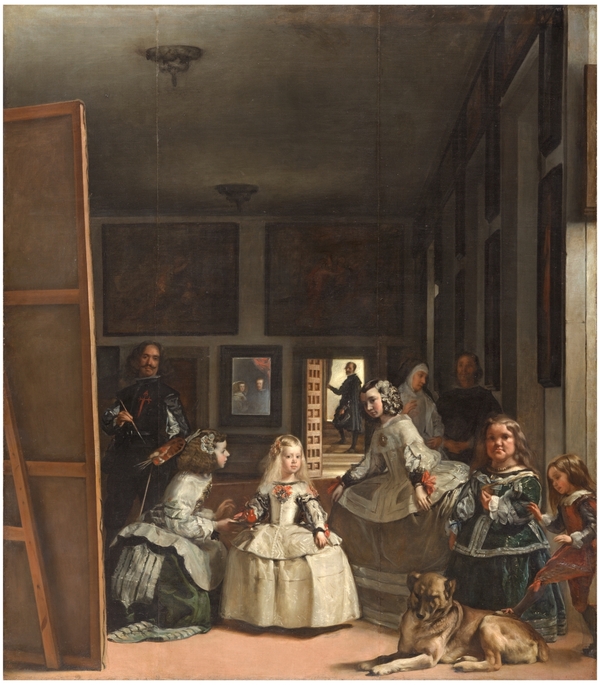
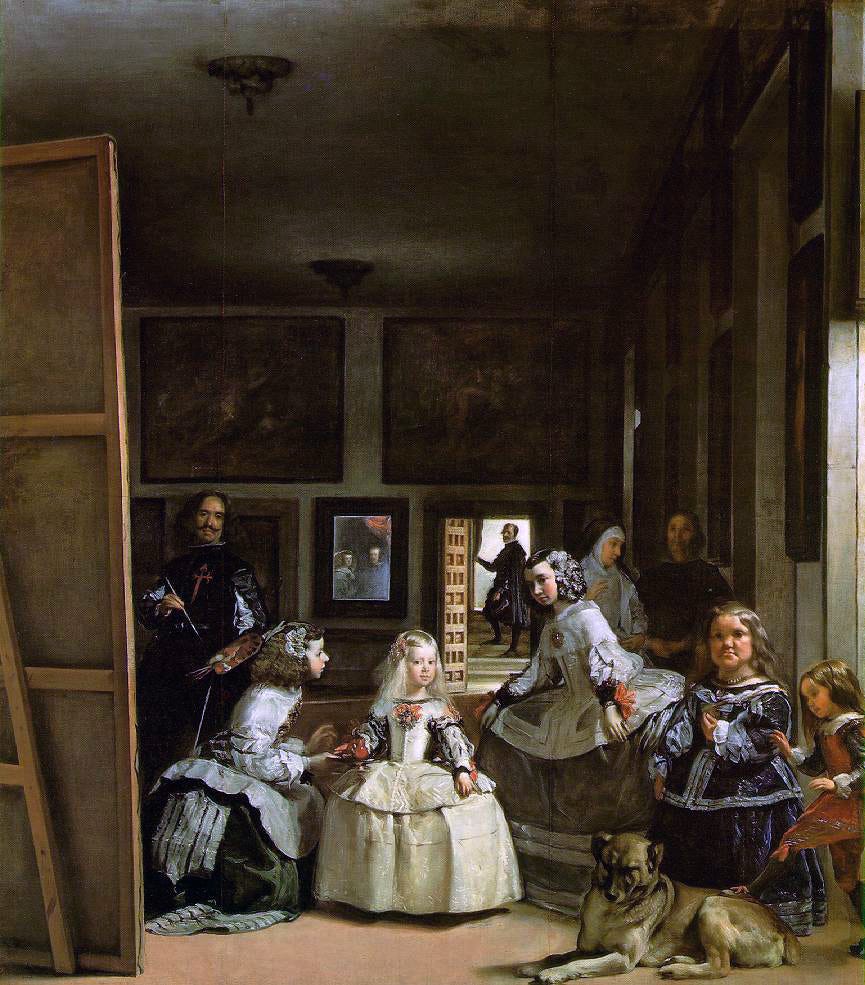
A cat's-cradle of a composition, yet pure crystalline bliss to the eye and mind, Las Meninas has been triggering esoteric ecstasies for centuries. To Luca Giordano, a Baroque master of the next generation, the work embodied a "theology of painting"; to Sir Thomas Lawrence, president of the Royal Academy from the late Regency into the early reign of George IV, it epitomized "the true philosophy of the art." More prosaically, the rock-star art critic of the latter 20th century Robert Hughes judged Las Meninas "perhaps the greatest nonmythical, secular painting in all art history." No one is contradicting.
La Tela Real has never enjoyed that kind of prestige. Yet on a split screen, the contrasts between the two paintings set off its qualities in ways that are quite miraculous. Anticipating mega Polaroids, Las Meninas captures a private indoor moment with a handful of Spanish Habsburgs and dependents they know and care about, all shot (as it were) from the perspective of a man with his feet on the ground. Harmony reigns. We who look on are part of the picture.
And La Tela Real? La Tela Real is a clip from a newsreel, catching royals on parade in the open air amid crowds no one head can keep track of, driven by their whims. The random movements we watch from midair and far away add up to a microcosm of the Human Comedy, 17th-century Spanish style. Don't bother looking for a Velázquez selfie, as in Las Meninas. In La Tela Real, he's taking the God's-eye view.