



\
Critic's choice
Gary Oldman—our vote for best screen actor of the year
Connoisseur, October 1990
If the movies he has played in tell the truth about him, Gary Oldman is not scared of the dark. He courts it; he revels in it; he flies to it like the moth to the flame. His face is never more radiant than an instant before the lights go out.
Oldman's career is still young. Sid and Nancy, in which he made his film debut, came out four years ago; Prick Up Your Ears, a year later. In the first, he played the punk rocker Sid Vicious; in the second, the playwright Joe Orton—a pair of self-exterminating fallen angels from real life who skyrocketed to fame from working-class origins, died young, and went to pop heaven. If, as is very possible, you never have heard of him, you will.
After those two performances, the flashy London magazine Blitz called Oldman "without doubt Britain's most upwardly mobile young actor." American critics, too, were quick to catch on, even the most main-line of them. Oldman's most recent film, Chattahoochee, in which he plays a destitute Korean War hero driven to despair (another character drawn from real life), occasioned this extraordinary compliment from the New York Times: "The London-born Mr. Oldman projects a rare strength and dignity, transforms himself utterly into a rawboned American Southerner, and suggests that this performance may be deeper and more gripping than the real man or his real story."
"Movies don't evaporate," Oldman remarks in New York between projects, wearing wire-rim glasses and poet's-length hair, speaking in a soft London accent, and looking worried. Is the case especially delicate playing real people? "It's good and bad. In Sid and Nancy, I had to go some way towards looking like Sid Vicious—tall, in his leather jackets. In a fictional part, everything like that—hair, clothes—is up to the imagination. With real people you have a certain responsibility to living relatives—you're playing their souls."
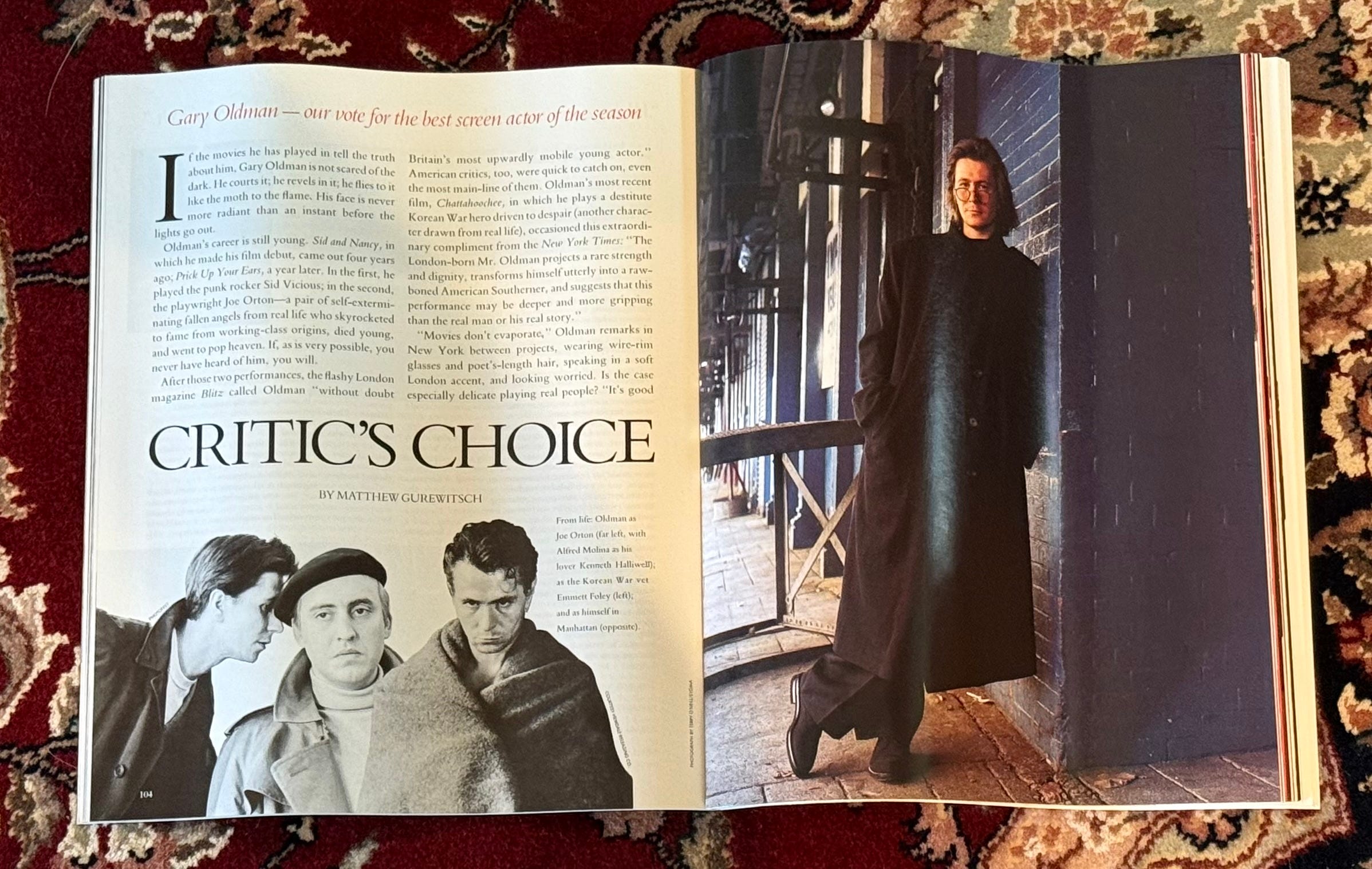
Despite his success with critics and cult audiences for Sid and Nancy and Prick Up Your Ears, the general audience paid scant attention, and the string of Oldman pictures that have come out since—Track 29, We Think The World of You, Criminal Law, Chattahootchee—has fared worse. But this month brings Oldman's two latest, and these have commercial potential. In Rosencrantz and Guildenstern Are Dead, directed by Tom Stoppard from his own showily literate hit play, he is Rosencrantz ("Stan Laurel," the actor calls him, "the dumb one, who gets it wrong"), falling into Shakespeare's Hamletlike Alice into a lethal wonderland. In State of Grace, Phil Joanou's brooding, brutal saga of the Irish mafia in that derelict corner of Manhattan formerly known as Hell's Kitchen, he costars as the psychotic killer Jackie Flannery, stealing the film from costars Sean Penn and Ed Harris.
Oldman was born thirty-two years ago in New Cross, a dead-end pocket of southeast London from whose poverty escape is all but unknown. Oldman's prospects when he was a boy cannot have seemed much better to him or the neighbors than anyone else's. Leaving school "with hardly any qualifications" at fifteen, he went to work in a sports shop. But then, at the movies, he saw If..., Lindsay Anderson's nightmare of revolt in a British boarding school. The starring performance by Malcolm McDowell—a twentieth-century satyr, bold of step, bright of eye—as the machine-gun-toting leader of the student rebels sent Oldman heading off for drama school, which he judges now to have been largely a waste of time. Regional theater followed, and a half dozen shows at London's Royal Court Theatre—a bulwark for Britain's angry young men—plus a stint with the Royal Shakespeare Company, contemporary division.
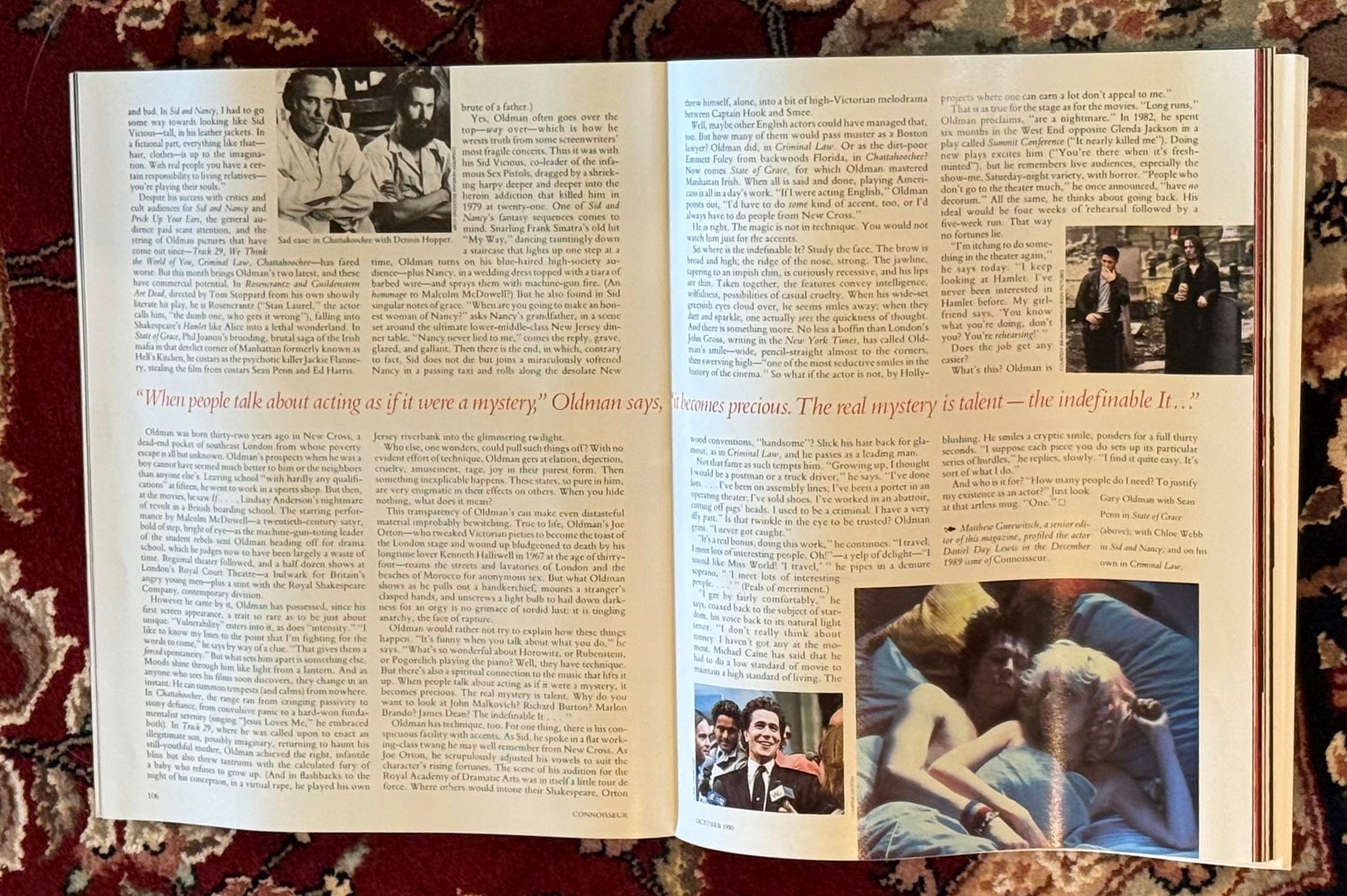
However he came by it, Oldman has possessed, since his first screen appearance, a trait so rare as to be just about unique. "Vulnerability" enters into it, as does "intensity." "I like to know my lines to the point that I'm fighting for the words to come," he says by way of a clue. "That gives them a forced spontaneity." But what sets him apart is something else. Moods shine through him like light from a lantern. And as anyone who sees his films soon discovers, they change in an instant. He can summon tempests (and calms) from nowhere. In Chattahoochee, the range ran from cringing passivity to stony defiance, from convulsive panic to a hard-won fundamentalist serenity (singing "Jesus Loves Me," he embraced both). In Track 29, where he was called upon to enact an illegitimate son, possibly imaginary, returning to haunt his still-youthful mother, Oldman achieved the right, infantile bliss but also threw tantrums with the calculated fury of a baby who refuses to grow up. (And in flashbacks to the night of his conception, in a virtual rape, he played his own brute of a father.)
Yes, Oldman often goes over the top-way over—which is how he wrests truth from some screenwriters' most fragile conceits. Thus it was with his Sid Vicious, co-leader of the infamous Sex Pistols, dragged by a shrieking harpy deeper and deeper into the heroin addiction that killed him in 1979 at twenty-one. One of Sid and Nancy's fantasy sequences comes to mind. Snarling Frank Sinatra's old hit "My Way," dancing tauntingly down staircase that lights up one step at a time, Oldman turns on his blue-haired high-society audience—plus Nancy, in a wedding dress topped with a tiara of barbed wire—and sprays them with machine-gun fire. (An homage to Malcolm McDowell?) But he also found in Sid singular notes of grace. "When are you going to make an honest woman of Nancy?" asks Nancy's grandfather, in a scene set around the ultimate lower-middle-class New Jersey riverbank into the glimmering twilight.
Who else, one wonders, could pull such things off? With no evident effort of technique, Oldman gets at elation, dejection, cruelty, amusement, rage, joy in their purest form. Then something inexplicable happens. These states, so pure in him, are very enigmatic in their effects on others. When you hide nothing, what does it mean?
This transparency of Oldman's can make even distasteful material improbably bewitching. True to life, Oldmans's Joe Orton—who tweaked Victorian pieties to become the toast of the London stage and wound up bludgeoned to death by his longtime lover Kenneth Halliwell in 1967 at the age of thirtyfour—roams the streets and lavatories of London and the beaches of Morocco for anonymous sex. But what Oldman shows as he pulls out a handkerchief, mounts a stranger's clasped hands, and unscrews a light bulb to hail down darkness for an orgy is no grimace of sordid lust: it is tingling anarchy, the face of rapture.
Oldman would rather not try to explain how these things happen. "It's funny when you talk about what you do," he says. "What's so wonderful about Horowitz, or Rubenstein, or Pogorelich playing the piano? Well, they have technique. But there's also a spiritual connection to the music that lifts it up. When people talk about acting as if it were a mystery, it becomes precious. The real mystery is talent. Why do you want to look at John Malkovich? Richard Burton? Marlon Brando? James Dean? The indefinable It .. . "
Oldman has technique, too. For one thing, there is his conspicuous facility with accents. As Sid, he spoke in a flat working-class twang he may well remember from New Cross. As Joe Orton, he scrupulously adjusted his vowels to suit the character's rising fortunes. The scene of his audition for the Royal Academy of Dramatic Arts was in itself a little tour de force. Where others would intone their Shakespeare, Orton threw himself, alone, into a bit of high-Victorian melodrama between Captain Hook and Smee.
Well, maybe other English actors could have managed that, too. But how many of them would pass muster as a Boston lawyer? Oldman did, in Criminal Law. Or as the dirt-poor Emmett Foley from backwoods Florida, in Chattahoochee? Now comes State of Grace, for which Oldman mastered Manhattan Irish. When all is said and done, playing Americans is all in a day's work. "If I were acting English," Oldman points out, "I'd have to do some kind of accent, too, or I'd always have to do people from New Cross."
He is right. The magic is not in technique. You would not watch him just for the accents.
So where is the indefinable It? Study the face. The brow is broad and high; the ridge of the nose, strong. The jawline, tapering to an impish chin, is curiously recessive, and his lips are thin. Taken together, the features convey intelligence, wilfulness, possibilities of casual cruelty. When his wide-set greenish eyes cloud over, he seems miles away; when they dart and sparkle, one actually sees the quickness of thought. And there is something more. No less a boffin than London's John Gross, writing in the New York Times, has called Oldman's smile—wide, pencil-straight almost to the corners, then swerving high—"one of the most seductive smiles in the history of the cinema." So what if the actor is not, by Hollyood conventions, "handsome"? Slick his hair back for glamour as in Criminal Law, and he passes as a leading man.
Not that fame as such tempts him. "Growing up, I thought I would be a postman or a truck driver," he.says. "I've done lots ... . I've been on assembly lines; I've been a porter in an operating theater; I've sold shoes. I've worked in an abattoir, cutting off pigs' heads. I used to be a criminal. I have a very iffy past." Is that twinkle in the eye to be trusted? Oldman grins. "I never got caught."
"It's a real bonus, doing this work," he continues. "I travel; I meet lots of interesting people. Oh!"—a yelp of delight—"! sound like Miss World1 'I travel,'" he pipes in a demure soprano; " 'I meet lots of interesting people .... '" (Peals of merriment.)
"I get by fairly comfortably," he says, coaxed back to the subject of stardom, his voice back to its natural light tenor. "I don't really think about money. I haven't got any at the moment. Michael Caine has said that he had to do a low standard of movie to maintain a high standard of living. The projects where one can earn a lot don't appeal to me."
That is as true for the stage as for the movies. "Long runs," Oldman proclaims, "are a nightmare." In 1982, he spent six months in the West End opposite Glenda Jackson in a play called Summit Conference ("It nearly killed me"). Doing new plays excites him ("You're there when it's freshminted"), but he remembers live audiences, especially the show-me, Saturday-night variety, with horror. "People who don't go to the theater much," he once announced, "have no decorum." All the same, he thinks about going back. His ideal would be four weeks of rehearsal followed by a five-week run. That way no fortunes lie.
"I'm itching to do something in the theater again," he says today. "I keep looking at Hamlet. I've never been interested in Hamlet before. My girlfriend says, 'You know what you're doing, don't you? You're rehearsing""
Does the job get any easier?
What's this? Oldman is blushing. He smiles a cryptic smile, ponders for a full thirty seconds. "I suppose each piece you do sets up its particular series of hurdles, " he replies, slowly. "I find it quite easy. It's sort of what I do."
And who is it for? "How many people do I need? To justify my existence as an actor?"
Just look at that artless mug.
"One."